
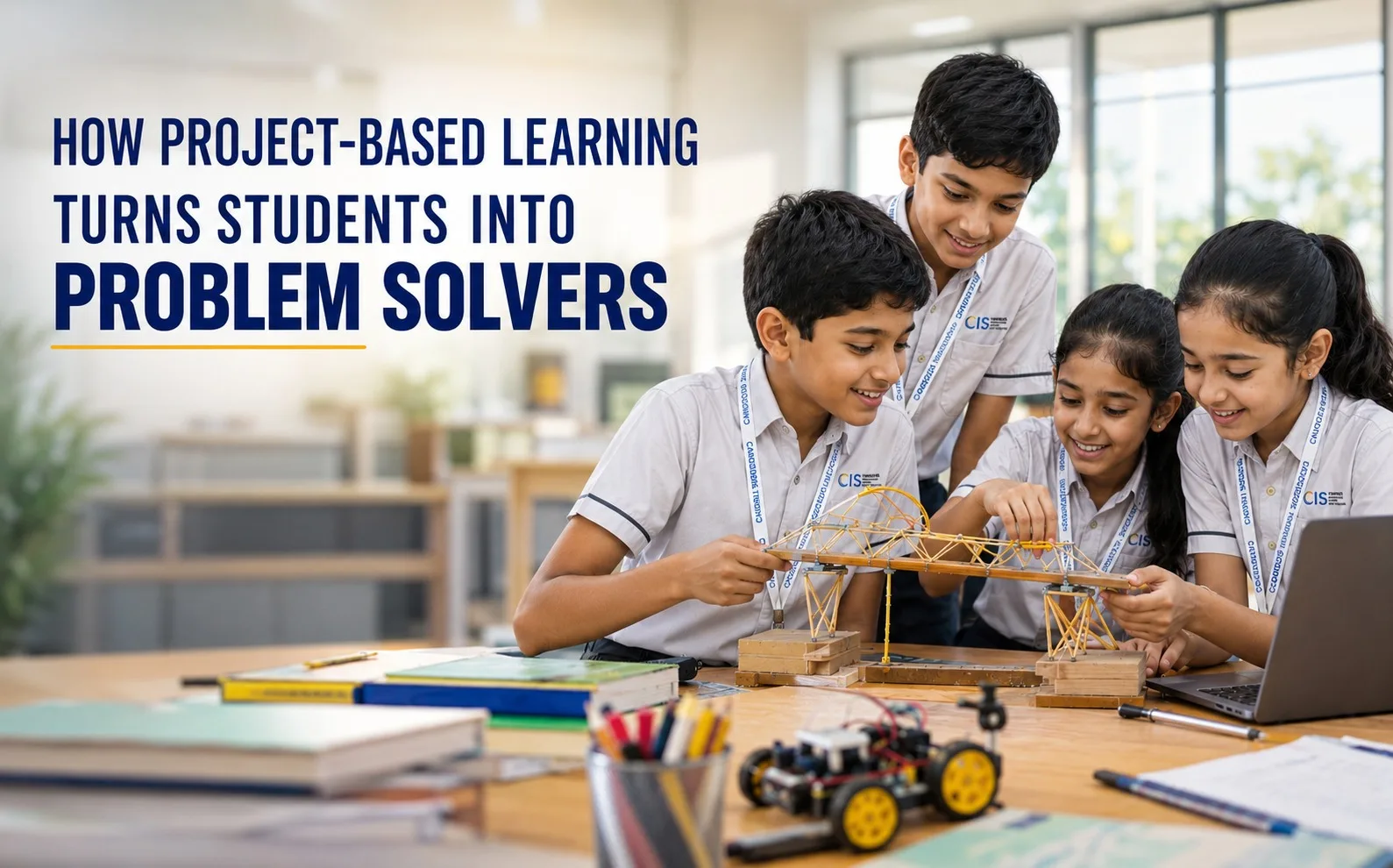
A classroom can teach children how to find the correct answer. But what happens when there is no single correct answer?
That’s where project-based learning comes in.
Instead of reading about a subject and answering questions, students get the chance to work on a problem, collect information, have group discussions about the issue, try out different ways of solving the problem, and say what they’ve found out. This learning makes knowledge more engaging and helps students understand how the knowledge acquired in class can be applied in different situations.
For parents looking for some of the best international schools in Hyderabad, this method of learning might be an important aspect in that it gives children an opportunity to hone their skills.
Project-based learning is a great way for students at Candiidus International School to cultivate curiosity and explore a subject in depth.
What Is Project-Based Learning?
Project-based learning is importantly defined as the gain of knowledge through various practical activities.
Instead of finishing the lesson and switching to the subsequent material immediately, students concentrate their efforts in resolving a question or achieving the desired result.
For instance, instead of merely reading about water conservation from a textbook, students can conduct research about how much water is consumed in their school.
During the process, students collect information, brainstorm ideas on how to prevent the waste of water, and prepare the recommendations to save the water.
So, they acquire knowledge not only of science and mathematics but also of real research methods.
Problems Become Learning Opportunities
It is natural for children to ask questions when they are curious about something. Project-based learning creates the possibility to let those questions be answered in detail.
Students might realize that the classroom temperature increases during the afternoon. Instead of saying, "It is hot," the teacher will turn this observation into a project.
The students may keep on asking some questions:
-
Why is the classroom getting hot?
-
Does the sunlight have something to do with the temperature?
-
Which parts of the classroom are warmer?
-
How to cool down the room?
Thus, the students have to make simple measurements and compare the data obtained.
Students Learn to Break Big Problems Into Smaller Ones
Certain difficulties may seem harder to deal with since they can be complicated and consist of many questions.
For instance, students are given a project of establishing a small garden in their school. To start with, they must think about possible plants. They also have to take into account space, sunlight, water, soil, expenses, and care.
Instead of solving the whole problem at once, students learn to divide their project into simpler steps.
One can use this strategy not only for schoolwork but also in everyday life.
Mistakes Become Part of the Process
One of the most valuable aspects of project-based learning is that the first attempt does not always have to work.
Consider a group of students building a bridge using paper or simple classroom materials. Their first design may collapse under pressure.
Rather than seeing that as a failed activity, the teacher can ask:
“What do you think caused it to collapse?”
Students may notice that the base was too narrow or that the materials were not distributed properly. They can change the design and try again.
Through this process, students learn that mistakes can provide useful information.
Working Together Teaches More Than Teamwork
A project includes a group of people, and group activities can provide useful information on children’s learning of cooperativeness, as one child may have the talent of drawing; another may be interested in research; the third child may be a confident presenter; and the fourth child may have a gift of organizing the work. The success of the project depends on the different talents working together.
At the same time, during the work on the project, the students learn to allocate responsibilities, accept ideas of other people, solve conflicts, and carry out their own contribution to the work on the project. Such experiences give children the understanding that solving problems does not always mean being the smartest among people.
Research Becomes More Meaningful
Students appreciate the significance of research when there is a real need to find information for a task.
For instance, if a project on how to minimize plastic waste is given to students, they will need to find what plastic is used for and where the waste usually goes, as well as possible alternatives.
So students do not investigate just because their assignment requires them to do so; they seek information that helps resolve a problem of interest to them.
It gives the research process a sense of meaning rather than monotony.
Students Learn to Explain Their Thinking
Finding a solution is only one part of problem-solving. Students also need to explain how they reached it.
A project presentation gives them an opportunity to describe their process, show their findings, answer questions, and listen to feedback.
A student might say, “We chose this design because it used less material but still held the weight.”
That single explanation shows reasoning, decision-making, and communication.
From Classroom Projects to Real-World Thinking
The skills developed through project-based learning are not limited to school projects.
A child who learns to ask questions, gather information, compare options, test ideas, and adjust an approach is developing habits that can be useful in many areas of life.
Whether they are planning a school event, solving a technical challenge, working on a university assignment, or eventually handling a professional responsibility, the basic thinking process remains valuable.
This is one reason families looking at the best international schools in Hyderabad may consider how much opportunity students receive to learn through practical experiences.
The Candiidus Approach
At Candiidus International School, learning is not limited to simply completing chapters. Opportunities for inquiry, projects, collaboration, presentations, and practical exploration can help students connect what they learn with situations beyond the textbook.
A project does not need to be complicated to be meaningful. A simple classroom question can become an investigation. An observation can become a discussion. A failed attempt can become a lesson.
The goal is to encourage students to remain curious and keep looking for better ways to understand and solve problems.
Preparing Students for an Unpredictable Future
Nobody can say exactly what careers today's students will choose or what challenges they will face as adults.
What schools can do is help them develop adaptable skills.
Students who are comfortable asking questions, testing ideas, working with others, learning from mistakes, and explaining their thinking are better prepared to approach unfamiliar situations.
For parents considering the best international schools in Hyderabad, project-based learning is therefore worth looking at as part of the larger educational experience.
At Candiidus International School, the aim is to help students move from simply asking, “What is the answer?” to ask, “How can I find the answer, and is there a better way to solve this?”
That shift can be the beginning of genuine problem-solving.
FAQs
1. What is project-based learning?
Project-based learning allows students to explore a question, topic, or real-world problem through research, discussion, experimentation, collaboration, and practical activities.
2. How does project-based learning improve problem-solving?
Students learn to identify problems, break them into smaller parts, research possible solutions, test ideas, learn from mistakes, and make improvements.
3. Does project-based learning support communication skills?
Yes. Students often need to discuss ideas with classmates, explain their decisions, prepare presentations, and answer questions about their projects.
4. How does Candiidus International School use practical learning?
Candiidus encourages students to connect academic concepts with practical experiences through inquiry, projects, collaboration, presentations, and activities that encourage independent thinking.
5. Why is problem-solving important for students?
Problem-solving helps students approach unfamiliar situations with confidence. It can support them academically while also preparing them for challenges in higher education, careers, and everyday life.
Keep reading
Related articles

Why Emotional Well-Being Matters Alongside Academic Success
Learn why emotional well-being matters alongside academic success and how Candiidus International School supports students’ overall development in Hyderabad.

Best International Schools in Hyderabad with Cambridge and CBSE Excellence
Discover why Candiidus stands among top Cambridge Schools in Hyderabad, offering global learning, academic excellence, and future-ready education.

Why Candiidus Is Among the Leading International Schools in Hyderabad India
Discover why Candiidus is among the leading international schools in Hyderabad India, offering global education, holistic learning, and future-ready skills.
Discussion
Comments
No comments yet. Be the first to share your thoughts.
Leave a comment
Comments are reviewed before they appear on this page.