
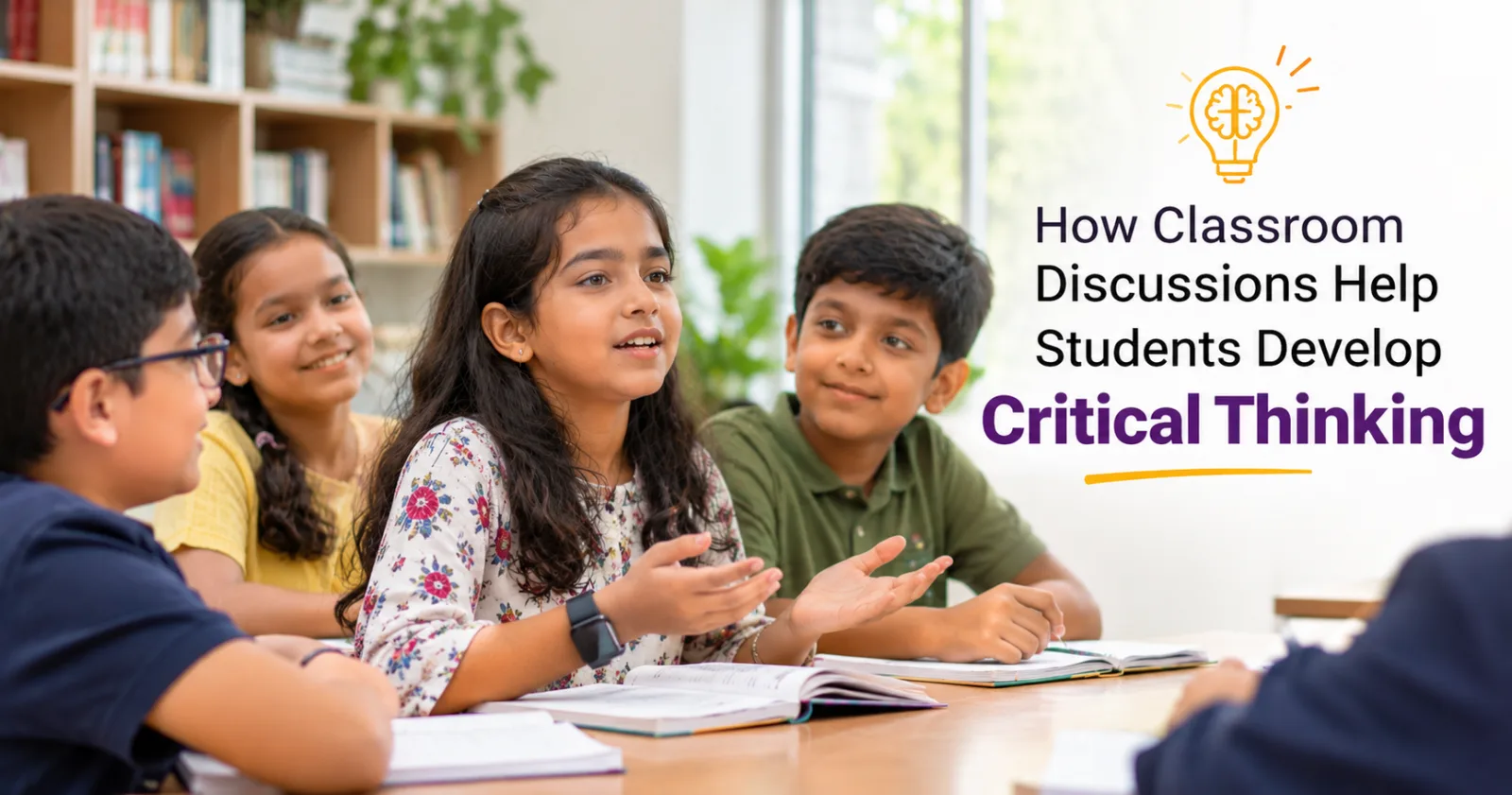
When learning becomes more meaningful, students should have the chance to express their thoughts, question, and articulate their ideas rather than simply memorizing facts. Class discussions enable learners to think independently, consider different viewpoints, and understand why people reach different judgments.
As an example, in discussing the need for more parks vs. shopping complexes, students must weigh public needs, ecological benefits, availability of land, etc. Such simple activity helps them to move beyond the immediate answer and think through the reasons behind their point of view.
This is why it is essential for many parents looking for Cambridge schools in Hyderabad to be interested in the learning environment that promotes discussions.
1. Students Learn to Question Information
Critical thinking is triggered when learners realize that data can be scrutinized, rather than taken for granted. Discussions in class will tap into students' questions such as, “Why does this happen?”, “How do we know that this statement is valid?”, and “Is there an alternative explanation?”
For example, during a science lesson, learners could be asked to think about why some bodies float while some sink. Instead of giving them the right response immediately, the teacher could ask students to guess the outcome and explain why they think that is so.
During the activity of testing different materials, students could compare their guesses with the actual outcomes. Thus, this activity gives them insight into the significance of evidence and rouses their curiosity.
2. Different Opinions Expand Students’ Perspectives
Students may start with their own views influenced by their experiences; hearing views and opinions of their classmates opens them up for new ideas.
In class discussions, opinions can vary: a student may think that doing homework daily is beneficial, while the other student may argue that children need to have enough time for their hobbies, family, and relaxation. Another option offered by students is shorter homework with more interesting activities.
Students should realize that there can be different answers to the same question, and they should also understand that a disagreement with the person does not allow them to reject the opinions of that person.
This skill of thinking about the opinions of other people is useful in the process of group work, at home, and in future jobs.
3. Explaining Ideas Strengthens Logical Thinking
Having an opinion is not the same as being able to articulate what makes that opinion valid. In class discussions students interact and give reasons for their opinions using examples and evidence.
A teacher might ask, “Which character in the story has taken the most important decision and why?” Students are required to recall specific events, look for the right details, and say how they back up their claim.
If their opinion is refuted by another student, they might have to think of some better examples or adjust their reasoning.
Little by little students learn how to systematize their thinking, spot weaknesses in their arguments, and present their views more clearly thereby being able to use this knowledge in other courses, e.g. literature, mathematics, biology, and sociology.
4. Students Develop the Confidence to Speak Up
Certain learners grasp a subject yet hold back from communicating owing to the dread of making errors. An encouraging discussion atmosphere assists them in enhancing their skills in conveying the ideas correctly without the need for precise answers.
The instructors may support the students’ involvement in the discussion by offering the students the chance to think beforehand when they are answering, permitting them to share opinions with one another as well as asking various students to share their thoughts.
To illustrate, a student who is not yet good at talking in front of the whole class may first communicate with a partner and, after listening to that person’s point of view, prepare themselves for the class discussion.
The purpose here is not to turn each child into the most loquacious speaker but rather to give each student the opportunity to speak confidently.
5. Classroom Discussions Teach Students to Evaluate Evidence
In addition, critical thinking requires the ability to tell the difference between an individual belief and a belief that is supported by trustworthy data.
During a social science class, students can compare two different accounts that tell the same story of a historical event. They can examine what each account says, how it manages to narrate the story, and what extra information may allow them to understand the event better.
The teacher can prompt students to answer the questions of who created the information, what proof supports its claims, or if there are any essential details missing.
These critical thinking skills are of great importance in the modern world where students deal with news, opinions, videos, or even AI content daily.
6. Collaboration Helps Students Improve Their Ideas
Group discussions are especially effective when people work together to find answers. Each student will have a different observation, finding another option and recognizing flaws in their original activities.
A task for the group of students can be to come up with an idea of a water-saving program for the school. The students may suggest using posters, making announcements in the classrooms, keeping the consumption record, and using reminders near the water tap.
The given activity is a nice mix of reasoning and collaboration. Students learn the process of negotiating, sharing tasks, assessing ideas, and improving an idea after receiving feedback.
While looking at Cambridge schools in Hyderabad, parents should watch for examples like these, which help kids engage in the studying process instead of just listening.
How Candiidus International School Can Encourage Thoughtful Learning
At Candiidus International School, classroom experiences that invite questions, discussion, investigation, and reflection can help students connect knowledge with practical situations. The value of these experiences lies in giving children opportunities to explain their thinking, consider alternatives, and learn from one another.
Parents comparing Cambridge schools in Hyderabad can ask how classroom discussions are conducted, whether students are encouraged to justify their answers, and how teachers support quieter learners.
Critical thinking does not develop through one debate or one classroom activity. It grows gradually whenever students are encouraged to ask meaningful questions, examine evidence, listen carefully, and revise their ideas when they discover something new.
By making thoughtful discussion a regular part of learning, schools can help students become more independent thinkers who are better prepared to understand challenges, make informed decisions, and approach unfamiliar situations with curiosity.
FAQs
1. What is critical thinking in education?
Critical thinking is the ability to analyse information, evaluate evidence, consider different viewpoints, and make reasoned decisions rather than accepting information without examination.
2. How do classroom discussions improve critical thinking?
Discussions encourage students to ask questions, explain their reasoning, compare perspectives, and support their conclusions with relevant examples or evidence.
3. How can teachers encourage students to participate in discussions?
Teachers can use open-ended questions, small-group activities, real-life examples, and a supportive classroom environment where students feel comfortable sharing ideas.
4. Are classroom discussions useful for all subjects?
Yes. Discussions can help students interpret stories, explain scientific observations, solve mathematical problems, and examine historical events from different perspectives.
5. Why should parents consider critical thinking when choosing a school?
Critical thinking helps children become independent learners who can assess information, solve problems, communicate clearly, and make thoughtful decisions.
Keep reading
Related articles

How Extracurricular Activities Help Students Discover Their Strengths
Discover how Candiidus International School uses extracurricular opportunities to help students explore interests and develop strengths in Hyderabad.

How Cambridge Schools in Hyderabad Develop Confident Global Citizens
Discover how Cambridge Schools in Hyderabad develop confident global citizens through communication, cultural awareness, critical thinking, and collaborative learning.

How Cambridge Schools in Hyderabad Build Critical Thinkers and Independent Learners
Discover how Cambridge Schools in Hyderabad help students develop critical thinking, independence, problem-solving skills, and confidence for future success.
Discussion
Comments
No comments yet. Be the first to share your thoughts.
Leave a comment
Comments are reviewed before they appear on this page.